Accessible Ichthyoliths Internship Program
Ichthyoliths (ick-thee-oh-liths), or “fish-stones”, are microfossil remains of fish and sharks, primarily in the form of teeth from both fish and sharks and denticles, or dermal scales, from sharks. Nearly invisible to the naked eye, these tiny but mighty fossils are the most abundant fossil record of fish and sharks on the planet, and when extracted from sediments, can reveal an incredible history of shark and fish evolution and ecology going back hundreds of millions of years.
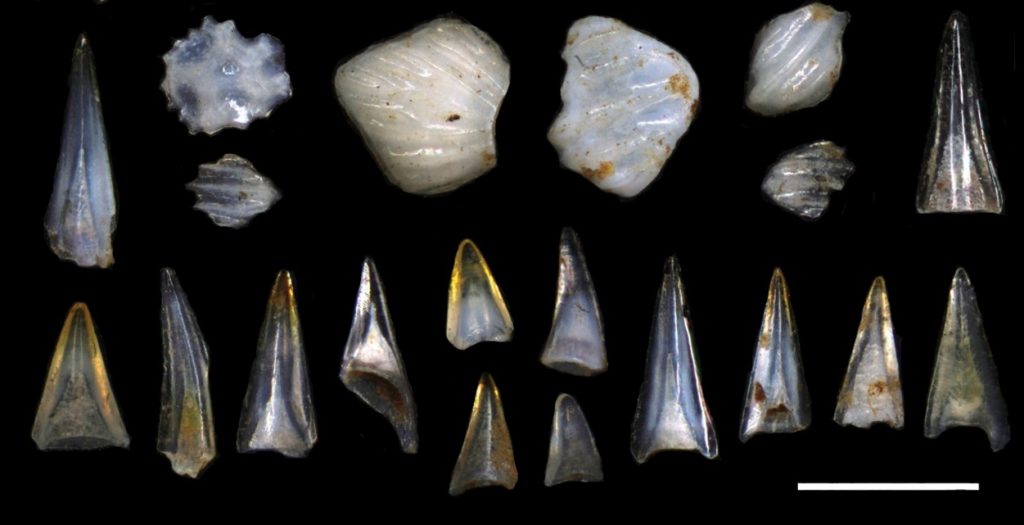
Eocene-aged (50 million year old) Ichthyoliths from the South Pacific Ocean. Pictured here are both teeth (triangles) and denticles (round ridged). The scale bar is 500 microns.
The Accessible Ichthyoliths program is a unique NSF-Funded summer internship program that supports undergraduate students to participate in accessible, interdisciplinary summer research and science communication projects focused on ichthyolith micropaleontology and oceanography at the Woods Hole Oceanographic Institution, in Woods Hole, MA. It is hosted out of the PaleoFISHES Lab with Dr. Elizabeth Sibert. This cohort-based program will support three students per summer for three summers (9 total students) to learn and develop their skills in STEM research and communication, using ichthyoliths as their primary entry-point to the professional world of paleontology and marine sciences. Accessible Ichthyoliths has a goal of improving accessibility and disability access to micropaleontology, oceanography and STEM research, and all students interested in contributing to accessible research and science communication are encouraged to apply.
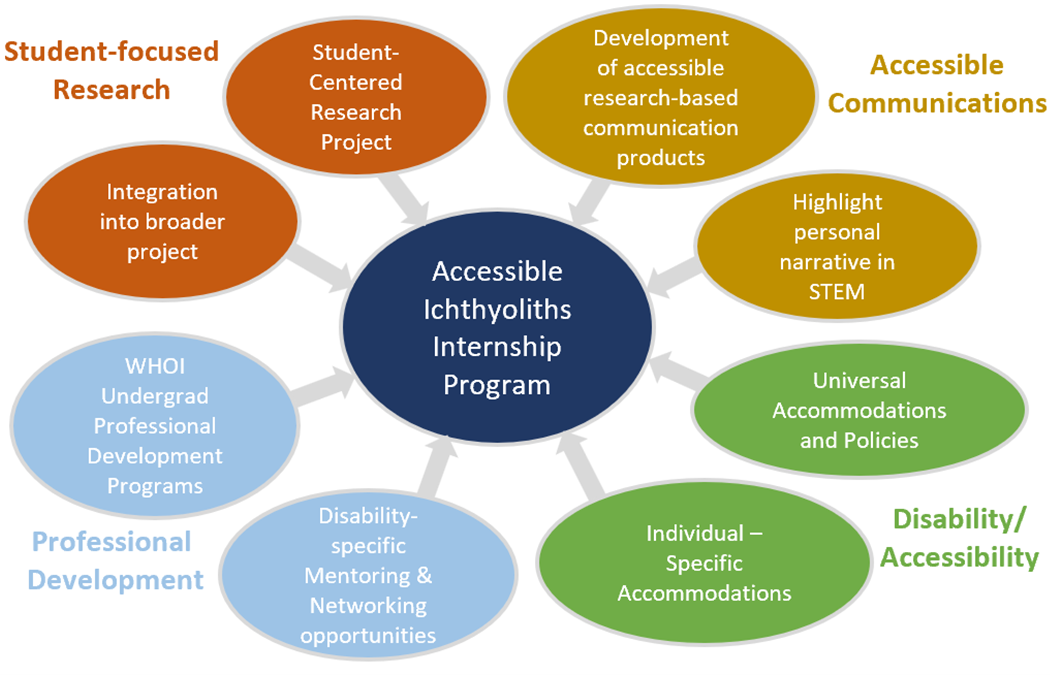
Accessible Ichthyoliths Program Components include Research, Communication, Professional Development and Accessibility
The Accessible Ichthyoliths program has two tracks with complimentary goals: Research-focus and Communication-focus. Those on the research track will follow a more traditional summer undergraduate research experience, developing and executing an independent ichthyolith-based research project, while also contributing to the ongoing accessible science communications efforts in the lab. Those on the communications track will focus on developing their own unique accessible science communications products (e.g. videos, podcasts, articles, lesson plans, etc.) and will contribute to data collection and analyses for ongoing research projects in the lab. Students on the communications track will be paired with a mentor in the WHOI Communications office, and students on the research track will be paired with a research mentor related to their project. Students on both tracks will contribute meaningfully to both research and communication efforts throughout the summer.
POTENTIAL PROJECTS:
Research: Interns will have the opportunity to work on projects relating to many areas of ichthyolith micropaleontology. The primary projects include generating novel ichthyolith records from different periods in Earth’s history (e.g. across mass extinctions, rapid global warming and cooling events, etc.,). Additional projects include developing AI models for ichthyolith identification, exploring the response of marine ecosystems to mass extinctions, and developing catalogues of modern fish and shark ichthyoliths, to calibrate fossil morphology to taxonomy and ecology, and more. Prospective interns are encouraged to review the Research and People pages on the PaleoFISHES website to get an idea of current research in the lab. Projects are constantly being developed, and interns will be encouraged to put their own spin on the ongoing and newly developing research projects during their summer internship.
Communications: There are a large number of possible directions for communications track interns, including developing 3D printed models of ichthyoliths and lesson plans, videos of lab techniques and projects, podcasts about researchers and projects, writing press releases and articles about ongoing research, social media posts, art projects inspired by ichthyolith research, and more. The primary expectation is that the communications products will employ universal design principles and widen the audiences that are traditionally reached by STEM communications, but there is considerable freedom in the format that these products will take. Have an idea of an accessible communications project that you think might fit? Pitch your idea as part of your application!
PROGRAM LOGISTICS:
Accessible Ichthyoliths consists of an 8-10-week research project, as well as professional development opportunities. Successful applicants will join the PaleoFISHES lab group for the summer, and be provided with a stipend ($680/week), housing on the WHOI campus, and travel support to and from WHOI for the summer up to $1000. Support for presentation of summer work at a regional or national conference presentation may be available as well. Accessible Ichthyoliths aims to provide opportunities for all students interested in ichthyolith-based research and science communication. Should a student need disability-related accommodations to participate fully (e.g. specific software, ASL interpretation, travel support for PCA, etc.), these will also be supported by the program. The program will take place in a wheelchair accessible lab space located on the WHOI Campus. Students will participate in professional development activities through the Summer Undergraduate Programming at WHOI, as well as several disability-in-STEM-specific activities through this program. Remote participation is an option and will be considered on a case-by-case basis, although students will be supported and encouraged to participate in person if possible. Questions about what these logistics mean for you? Please reach out to accessibleichthyoliths@gmail.com.
ELIGIBILITY:
Accessible Ichthyoliths is open to all undergraduate students who are interested in improving accessibility and disability access in STEM research and communications. This interdisciplinary program welcomes students in relevant STEM disciplines (e.g. biology, geology, environmental sciences, oceanography, etc.) as well as those whose majors are in communications, education, or other humanities disciplines who want to participate in STEM research, communications, and accessibility. Prior research experience is not required or expected. Preference will be given to highly motivated students who have not had access to comparable research opportunities through their home institutions.
*Note that all students who apply to the program will be invited to participate in disability-specific professional development activities, independent of whether they are offered an internship position.
WHEN:
The 2026 summer internship cohort will be in residence at WHOI for 8-10 weeks in Summer 2026, between May 26, 2026 and September 11, 2026, most likely ~June 1, 2026 and August 7, 2026. Specific dates for each student participant may shift to accommodate university schedules (e.g. quarter system vs. semester system or other personal scheduling restrictions).
Note that this program will run for three summers (2026, 2027, and 2028), with a similar timeline each year.
APPLICATION PROCESS:
Application Deadline: February 13, 2026
LINK TO APPLICATION: https://forms.gle/zgnmurx7Qzz4fWao9
The application consists of:
- A series of five short answer questions (300 word limit for each question) that discuss your interest in participating in this internship program, your specific research interests, and how the program would benefit your personal and professional goals.*
- A CV or Resume and Transcripts for undergraduate coursework – please don’t pay for these: unofficial transcripts are sufficient at the application stage.
- The names and contact information of three people (e.g. faculty mentors, advisors, or other people who have interacted with you in a professional or educational setting) who are willing to write you a letter of recommendation.**
*If writing essays is not how you communicate most effectively, you are also welcome to submit a short video of yourself sharing your answer to each of these questions verbally (maximum of three minutes per question, please answer the questions in order and specify which question you are answering before answering it). This can be done as a private youtube video which is linked in the application at the end of the essay section. Please note that this is an OPTIONAL, ADDITIONAL tool you can use for your application. You are still expected to submit statements in writing for each question, and applications without a video will be weighted exactly the same as those who choose to opt into this alternative application option.
**Please note that letters of recommendation will only be solicited for short-listed students in late February-early March and will be submitted separately from the main application.
Application Timeline:
Applications are due on or before February 13, 2026. Short-listed students will be contacted in early March for a follow-up interview. Final notifications will be shared by March 31, 2026. In the summer of 2026, the program will run for 8-10 weeks between Please apply and we will work with you to make the dates work!
Frequently Asked Questions (FAQ):
- I don’t have a disability – can I still apply for this opportunity?
YES! Accessible Ichthyoliths is for all students who have an interest in engaging with disability-in-STEM efforts and improving disability access to STEM research and science communication, regardless of disability status.
- How do the research and science communication tracks work?
This program has two “tracks” which you can opt into – a research-focused track, which you will spend ~80% of your time developing and executing an ichthyolith-based research project and ~20% of your time contributing accessible science communication products, and a communications-focused track, where you will spend ~80% of your time developing accessible communications products, and ~20% of your time contributing to an ongoing research project in the lab. If you are struggling to pick a track, that is ok! We can work with you to define your summer projects in the best way possible to help you reach your research and communications goals, and these percentages are just estimates.
- What do you mean when you say disability and disability access in STEM?
A person with a disability is defined under the Americans with Disabilities Act (ADA) as “a person who has a physical or mental impairment that substantially limits one or more major life activity. This includes people who have a record of such an impairment, even if they do not currently have a disability. It also includes individuals who do not have a disability but are regarded as having a disability.”
People are considered to have a disability if they have a physical or mental impairment or medical condition that substantially limits a major life activity, or if they have a history or record of such an impairment or medical condition. According to the ADA, disabilities include, but are not limited to:
- Autism
- Autoimmune disorder, for example, lupus, fibromyalgia, rheumatoid arthritis, or HIV/AIDS
- Blind or low vision
- Cancer
- Cardiovascular or heart disease
- Celiac disease
- Cerebral palsy
- Deaf or hard of hearing
- Depression or anxiety
- Diabetes
- Epilepsy
- Gastrointestinal disorders, for example, Crohn’s Disease, or irritable bowel syndrome
- Intellectual disability
- Missing limbs or partially missing limbs
- Nervous system condition for example, migraine headaches, Parkinson’s disease, or Multiple sclerosis (MS)
- Psychiatric condition, for example, bipolar disorder, schizophrenia, PTSD, or major depression
You do not need to identify as having a disability to participate in this program, and there are no restrictions on disability type or access needs for participation in this program – all you need is an interest in increasing access for disabled people in STEM – be it through developing accessible outreach materials, lesson plans, lab techniques, or other relevant activities.
- Are there other eligibility criteria?
This program follows the policies concerning NSF funding for undergraduate research opportunities. From NSF: “Eligible Student Participants: Undergraduate student participants supported with NSF funds in either REU Supplements or REU Sites must be U.S. citizens, U.S. nationals, or permanent residents of the United States. An undergraduate student is a student who is enrolled in a degree program (part-time or full-time) leading to a baccalaureate or associate degree. Students who are transferring from one college or university to another and are enrolled at neither institution during the intervening summer may participate. High school graduates who have been accepted at an undergraduate institution but who have not yet started their undergraduate study are also eligible to participate. Students who have received their bachelor’s degrees and are no longer enrolled as undergraduates are generally not eligible to participate.”
Additionally, students must be over the age of 18 to participate in this program at WHOI.
- Why do you need my transcripts? Will GPA be considered?
We recognize that your GPA may not tell the full story of your academic progress to date or future potential, so it is not a primary factor in our evaluation process. However, your transcripts do provide valuable information about which courses you have taken, and this will be used to help determine appropriate project fit and place your experiences within context.
- How are projects chosen?
Students can indicate a preference for specific research or communications topics in their application. Final project matches will be based on student interest and project availability, and students accepted into the program should expect to work with their mentor to develop their project ideas in the months leading up to the summer to maximize their time in the program.
- Do I have to disclose my disability status to others in the program or my lab?
Disclosure is not required, and students may choose whether and how they disclose a disability or any specifics related to a disability if they so choose. Note that in order for us to support you in the program, we will need to work with you to ensure that appropriate accommodations are available and accessible, so this will become a conversation should you be admitted into the program. Any disability-related information disclosed to the program will be kept confidential to those at WHOI who need to know in order to support you during the program.
- Will there be disabled mentors? Who is running this program anyway?
This program is supported and run by folks with a variety of disabilities, as well as non-disabled folks with a passion for accessibility. A central tenant from the disability community is “Nothing About Us Without Us”, and this program adheres to this principle. Students will be matched with disabled mentors to discuss accessibility of their work and will be introduced to a wide range of individuals living and working around the country who are working on accessibility in STEM research and communication.
** If you are a graduate student or researcher who identifies as disabled and/or having a disability, and you want to be involved in this program as a mentor, please reach out to us at accessibleichthyoliths@gmail.com or fill out this google form and we'll reach out to you.
If you have additional questions, please reach out to accessibleichthyoliths@gmail.com.
 This program is supported by NSF-GEO award #2441428, CAREER: TINY FISH: Toolkit, Innovation, and Natural HistorY of Fossil Ichthyoliths and their Sedimentary History.