
Larval transport by internal bores and waves and Other Processes
The problem of larval transport by internal tidal bores has multiple facets, and the phenomena involved occur at a variety of temporal and spatial scales, from the fine-scales of larval accumulation at propagating fronts, to the large-scale geophysical modulation of the internal bores. In this page we describe two different aspects.
The two-way transport of larvae by internal tidal bores hypothesis
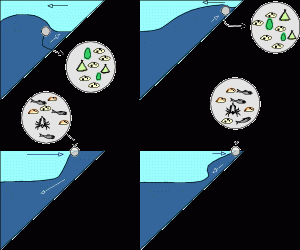
- The advection of masses of water by the internal tidal bores (dark blue bodies inside triangles) transports onshore larvae associated to the thermocline or living close to the sea-floor (upper panels) (Pineda, 1991; Leichter et al., 1998).
- The cold water pushes the warm water offshore, creating a front that can be found up to at least 2 km from the shore.
- As the cold water sinks because of gravity, the currents reverse direction and now the warm water travels shoreward at the surface, and offshore at the bottom. The front dividing cold and warm water concentrates and transports neustonic larvae (lower panels). (Pineda, 1994, J. mar. Res.; 1999 Limn. & Ocean.) Click here for an internal-bore warm-water front (~55 kB file).
Low-frequency modulation and spatial variability of the process
The temporal modulation might involve processes with fortnightly periodicity, but these processes are currently unknown. On the other hand, there is strong evidence that coastally trapped waves associated with changes in the wind field modulate the internal bores. We believe that this process occurs as follows (Pineda and Lopez, 2002).
- The internal tide is common in coastal, relatively deep waters.When the thermocline is deep, if is far from the shore, and in these cases the internal tide is not observed near the shore. That is, when the thermocline is deep, the internal tide does not influence the near shore environment nor the bores transport larvae to the shore
- As coastally trapped waves propagate poleward, they produce a small change in sea-level, with a corresponding change in thermocline depth, but of much larger vertical scale. When the sea level drops a few cm, the thermocline shallows several m, and as the thermocline shallows, the internal tide and the internal tidal bores are observed near the shore, and this is precisely when larval transport by internal tidal bores occur. In summary, when the thermocline shallows, the internal tide also shallows, and larval transport by internal bores occurs.
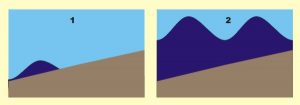
The hypothesis that nearshore, shallow internal tidal bores result from the low frequency shallowing of the thermocline states that low frequency events raise the thermocline allowing the occurrence of the internal tidal bores close to the surface and at the nearshore. In short, the wave-guide moves up and, consequently, inshore.
We have also evidence that El Niño may modulate larval transport by internal motions. During the warm phase of ENSO, nearshore stratification is reduced, with a decrease in high-frequency internal motions, and barnacle settlement (Pineda et al., 2018).
Finally, we have found that spatial differences in stratification influence the internal tidal bores
(See Pineda and Lopez [2002] -pdf link-)
Generality of the mechanism
Internal tidal bores are one of the three competing hypotheses explaining shoreward transport of invertebrate larvae (but there must be more mechanisms, of course!). Recent studies in other regions demonstrate this mechanism to be widespread. Furthermore, this process may be key in explaining onshore transport of nutrients and discharged pollutants. Our lab continues to work on small and large scale aspects of larval transport by internal tidal bores, in the field, in the lab, and with models. Larval transport by internal tidal bores is one of the best known larval transport mechanisms in open coastline populations.
Funding Agencies
The National Science Foundation has funded this research.

Partners/Collaborators
Our collaborators include Manuel López (CICESE), Nathalie Reyns (USD), and Steve Lentz (WHOI)