Abundance of American lobster larvae and other organisms in small scale convergences
Project Overview
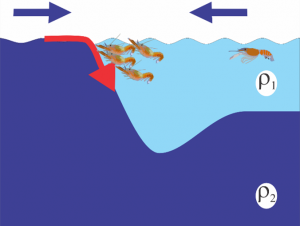
The project investigates how fine-scale physical features in the surface ocean, specifically surface convergences (zones where horizontal currents converge), influence the ecology of American lobster (Homarus americanus) postlarvae and other meroplankton, and holoplankton. These microhabitats, though common in the coastal ocean, remain poorly understood due to their dynamic and small-scale, patchy nature. By combining field surveys, experimental approaches, and image-based analyses, the project explores how small-scale hydrographic variability impacts larval abundance, condition, and broader community structure.
The objectives include:
- Assess aggregation potential
- Examine larval condition
- Characterize microhabitat variability
- Identify the physical processes that form the convergences
- Understand community-level interactions.
The key findings include:
- Convergences often displayed strong gradients in temperature and salinity but varied widely in structure.
- Highest postlarval abundances were often found within convergences, though patterns were inconsistent across sites.
- Comparisons with multi-year datasets suggest convergences enhance larval density relative to background levels.
- Survival rates were similar inside and outside convergences, but differences in color and size suggest potential habitat effects.
- Neuston community and physical measurements revealed high variability among convergences, reinforcing their dynamic nature.
This project highlights the ecological importance of small-scale, ephemeral surface microhabitats in shaping the distribution, condition, and potential connectivity of meroplankton such as lobster larvae. By demonstrating that convergences can act as temporary nurseries or hotspots for dispersing larvae, the work advances understanding of early life history dynamics, recruitment processes, and coastal ecosystem variability. It also emphasizes the need to integrate fine-scale physical processes into broader models of larval ecology and fisheries management.
Funding Agencies
The American Lobster Initiative, a NOAA Sea-Grant initiative, funded this research.
Partners/Collaborators
Collaboration with Carolyn Tepolt (WHOI)