Zenon Davidson (University of British Columbia) starts summer research at WHOI
On 26 May, Zenon Davidson arrived at WHOI, as a part of the WHOI Summer Student Fellowship, where he will research the relationship between clouds and surface radiative fluxes during the South Asian Monsoon using field campaign data (description below). Zenon is a rising senior undergraduate student majoring in Geophysics at the University of British Columbia. Welcome, Zenon!
Ship-Based Marine Cloud Analysis using Machine Learning Techniques
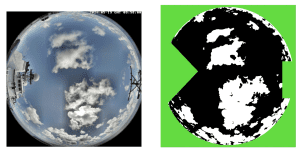
Figure 1: An example sky image from the R/V Thomas G. Thompson on the Bay of Bengal during the South Asian summer monsoon. Low cumulus clouds in the left image are identified by their red/blue color ratio to generate the cloud mask in the right image. This lets us determine cloud fraction, which determines how the clouds interact with the upper ocean.
The Tropical Climate Dynamics Lab is seeking a summer student fellow to conduct analysis of ship-based imagery of marine clouds to retrieve properties such as cloud fraction, thickness, type, height, and direction of motion. Marine clouds are important not only for their role in local weather, but also for air-sea interaction and global climate. The student will work with existing datasets over the Bay of Bengal and near Hawaii and may collect additional data in Woods Hole. Guidance will be provided to implement both traditional color ratio techniques and machine learning-based image segmentation. The student may also incorporate cloud datasets from colocated lidar and radar instruments.
Lab research theme: The Tropical Climate Dynamics Lab at WHOI studies atmospheric dynamics, clouds, and air-sea interaction over the tropical oceans. We have a particular focus on high-impact rainfall events. The potential project above would contribute to the lab’s goal of retrieving cloud properties over the ocean from remote sensing instruments carried on ships. These cloud datasets may be combined with air-sea flux datasets, weather balloon profiles, and reanalyses to quantify the impact of clouds on the upper ocean.
Desired interests: digital image processing, atmospheric dynamics, machine learning, air-sea interaction
New skills to be developed: image segmentation, cloud dynamics, computer vision, reading the sky