Comment in AGU Advances: the critical importance of evaluating polar geoengineering impacts on marine ecosystems
As climate change accelerates ice loss from Greenland and Antarctica, some researchers have proposed an audacious idea: build underwater barriers to block warm ocean currents from reaching glaciers, slowing their melt and buying time against sea level rise. It’s a compelling concept… but what would be the side effects?
In a commentary published in AGU Advances, my coauthors and I argue that there is already sufficient evidence to conclude that installing such barriers at Greenland’s largest glacier, Sermeq Kujalleq, would have serious unintended consequences for marine ecosystems and the communities that depend on them. I served as corresponding author on this study, which was recently highlighted by Eos.
Rather than proposing new experiments, we used existing field observations and representative numerical models to explore what would happen to the “glacier nutrient pump,” the process by which glacial meltwater entrains deep, nutrient-rich water and delivers it to the sunlit surface. This mechanism sustains a major phytoplankton bloom in Disko Bay and supports one of Greenland’s largest inshore fisheries. An artificial sill or curtain across the Icefjord would likely shut this system down.
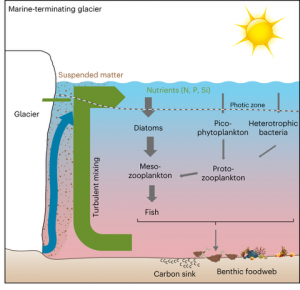
Greenland glacial meltwater flowing to fjords with marine-terminating glaciers can drive upwelling of nutrient-rich deep water by subglacial discharge plumes, which can stimulate phytoplankton productivity (figure and caption modified from Meire et al., 2023).
Our study also integrated local knowledge from the people of Ilulissat into the analysis, through interviews conducted by coauthor Sascha Schiøtt, a scientist at the Greenland Institute of Natural Resources. Their perspective was essential: the potential trade-offs of geoengineering cannot be evaluated in a vacuum. The people whose livelihoods depend on these ecosystems need to be part of the conversation from the start, not consulted after the fact.
As interest in climate intervention grows, this work underscores why careful science, including numerical modeling, must go hand in hand with meaningful engagement with local communities when evaluating proposed solutions.
Hopwood, M. J., Schiøtt, S., & Oliver, H. (2025). Glacier geoengineering may have unintended consequences for marine ecosystems and fisheries. AGU Advances, 6, e2025AV001732. https://doi.org/10.1029/2025AV001732
Feature photo credit: Mark Hopwood