Distributed Acoustic Sensing (DAS) to understand landfast ice evolution and breakup
Distributed Acoustic Sensing (DAS) turns ordinary fiber optic cables into long, continuous sensors by sending laser pulses through the cable and analyzing the returning light. This technique effectively transforms existing telecommunication lines on the seafloor into dense, passive arrays capable of detecting motion and vibration.
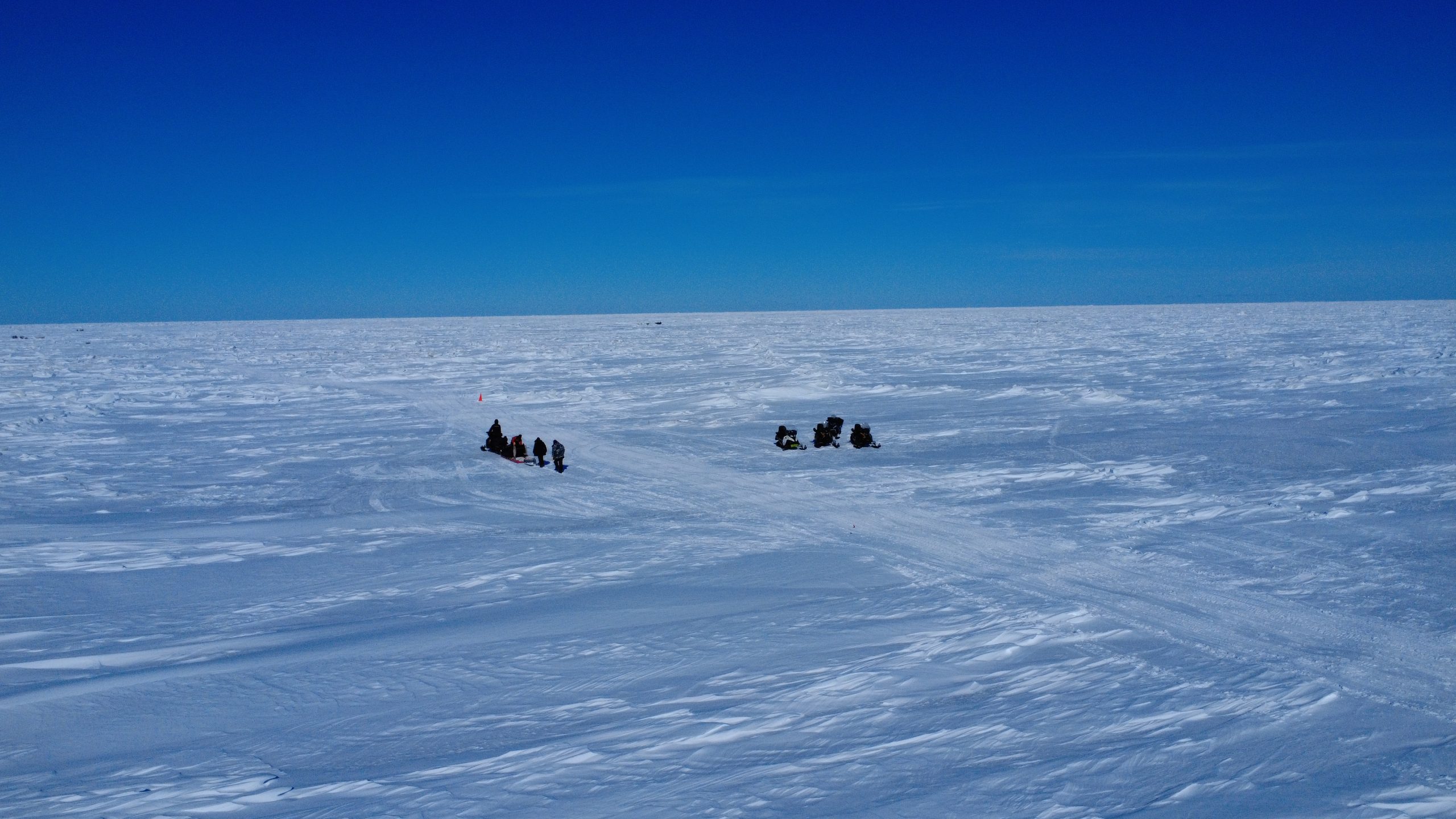
We are extending this capability into the Arctic, where traditional observing systems are difficult to deploy or maintain. By installing fiber optic cables directly on sea ice, we can monitor waves traveling through the ice with unprecedented detail. These observations give new insight into how the ice responds to changing ocean conditions, which has been extremely difficult to observe by any other means. Our approach brings together expertise in oceanography, sea ice physics, seismology, and signal processing to develop new ways of capturing changes in one of the world’s most dynamic and strategically important environments.
Coastal landfast sea ice, or ice that is attached to shore, plays a vital role in coastal stability and operational accessibility in Arctic environments. When this ice breaks, it can expose coastlines to damaging waves, disrupt travel, and change nearshore conditions rapidly. Our DAS-based observations aim to identify the conditions that lead to landfast ice breakup and to monitor ice thickness and wave attenuation in real time. Combined with complementary observing methods, this approach offers a novel, scalable, and persistent way to monitor an operationally challenging environment.

Funding Agencies
This research is funded by the National Science Foundation under grant number OPP-2336693.

Partners/Collaborators
Maddie Smith (WHOI; lead PI)
Junsu Jang (WHOI; postdoc)
Gil Averbuch (WHOI; collaborator)