Distributed Sensor Network - Brazil Basin
May 9 - June 10, 2026
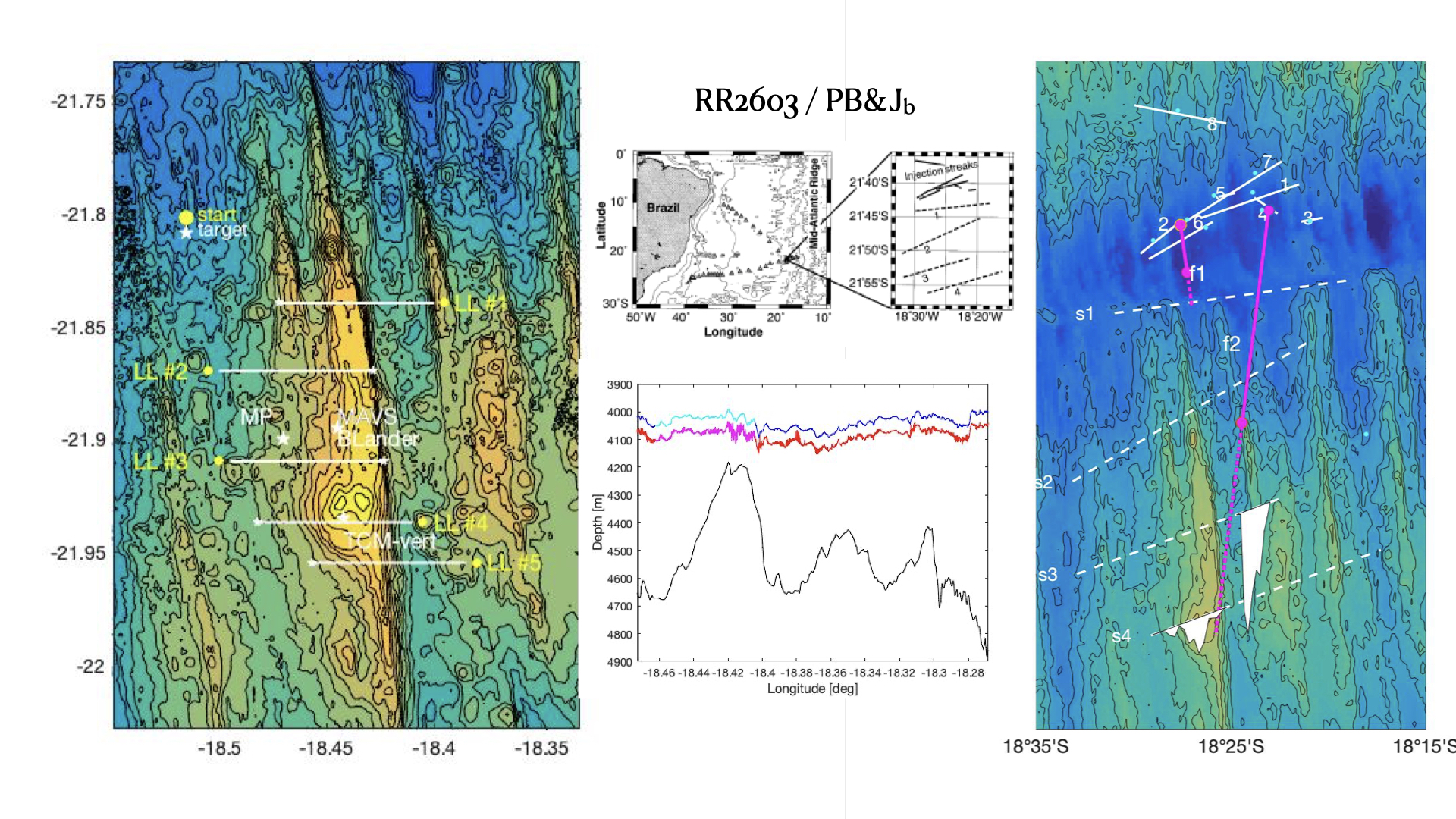
Slide 1: Center Top: figure 1 from Polzin et al. 1997 detailing full-depth fine- and microstructure stations using the High Resolution Profiler during the Brazil Basin Tracer Release Experiment in 1996. The cut-out details injection streaks (solid) and tracer sampling tows (dashed). Right: details of the injection and sampling tows with Multibeam topography obtained only during a subsequent cruise in 2000, Ledwell 2024. The solid magenta traces denote dissplacements of pop-up floats deployed at the injection and dashed magenta extensions extrapolate the observed float displacements to times at which sampling tows s1 and s4 were conducted. The white fill along the tow indicates tracer concentration obtained from a 50 chamber carousel sampler on the sled. From sampler placed above and below the sled, tracer concentrations indicate greater 'tails' and hence enhanced mixing on the southern most tow, s4. This tow went directly over a volcano on a abyssal hill ridge.
Center Bottom: blue trace indicates the depth of the sled and cyan overlay delimits the position where tracer was found in the carousel sampler. The red/magenta lines are displaced downward by 50 meters. Left: a close-up look at how Distributed Sensor Network assets were draped over the mountain. There are 5 Tilt Current Meter (TCM) long lines with 500 m tall vertical TCM extensions at the pentagrams. Positions of a Moored Profiler mooring, Modular Acoustic Velocity mooring, Bottom Lander and TCM vertical mooring are indicated by white pentagrams.
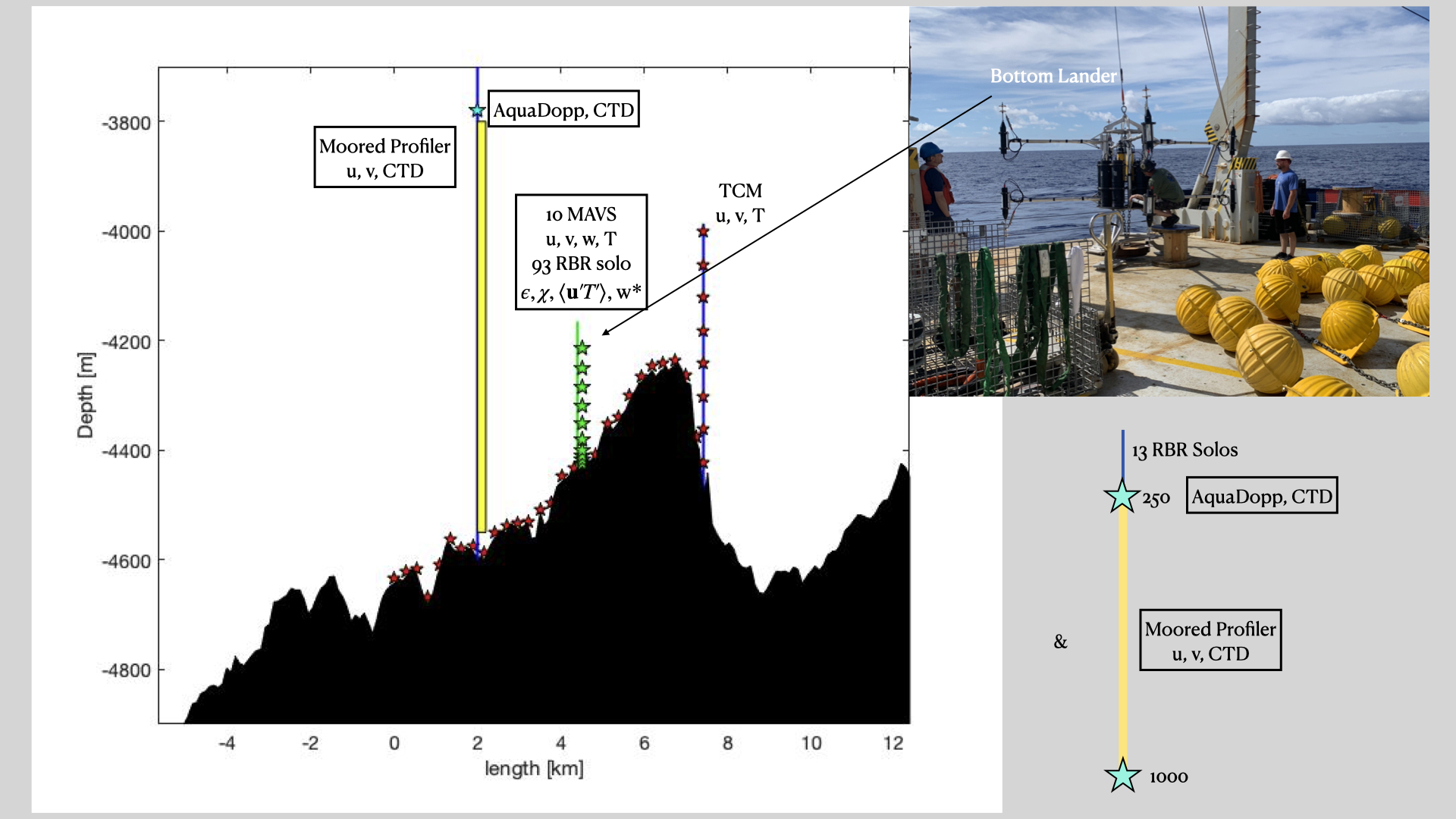
Slide 2: Left: Bathymetry along the centerline of the DSN with instrument positions. Bottom Right: extension of the Moored Profiler mooring into the thermocline. Upper right: The Bottom Lander sitting on deck.
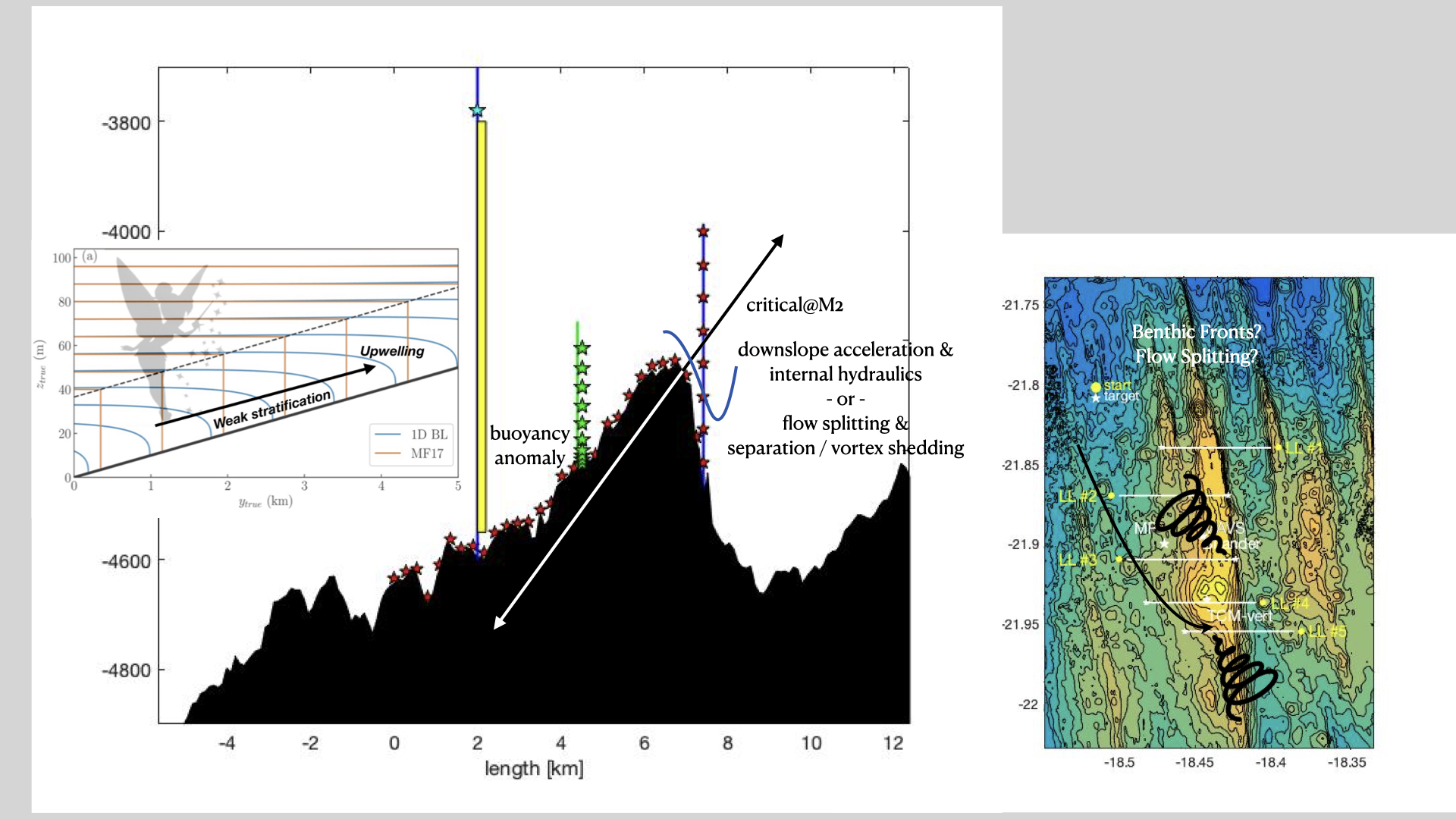
Slide 3: Our scientific targets, in cartoon fashion. (1) documenting that the buoyancy anomaly predicted by the 1-dimensional model (Garrett 1990, Ferrari et al., 2016) does not exist, for reasons discussed by Polzin and McDougall 2023; (2) structure and dynamics of the boundary layer the near-critical western face of the abyssal hill with topographic slopes of $1:7 \approx M_2/N$, dynamics over the super critical eastern face of flow blocking and internal hydraulics viz flow splitting and vortex shedding.
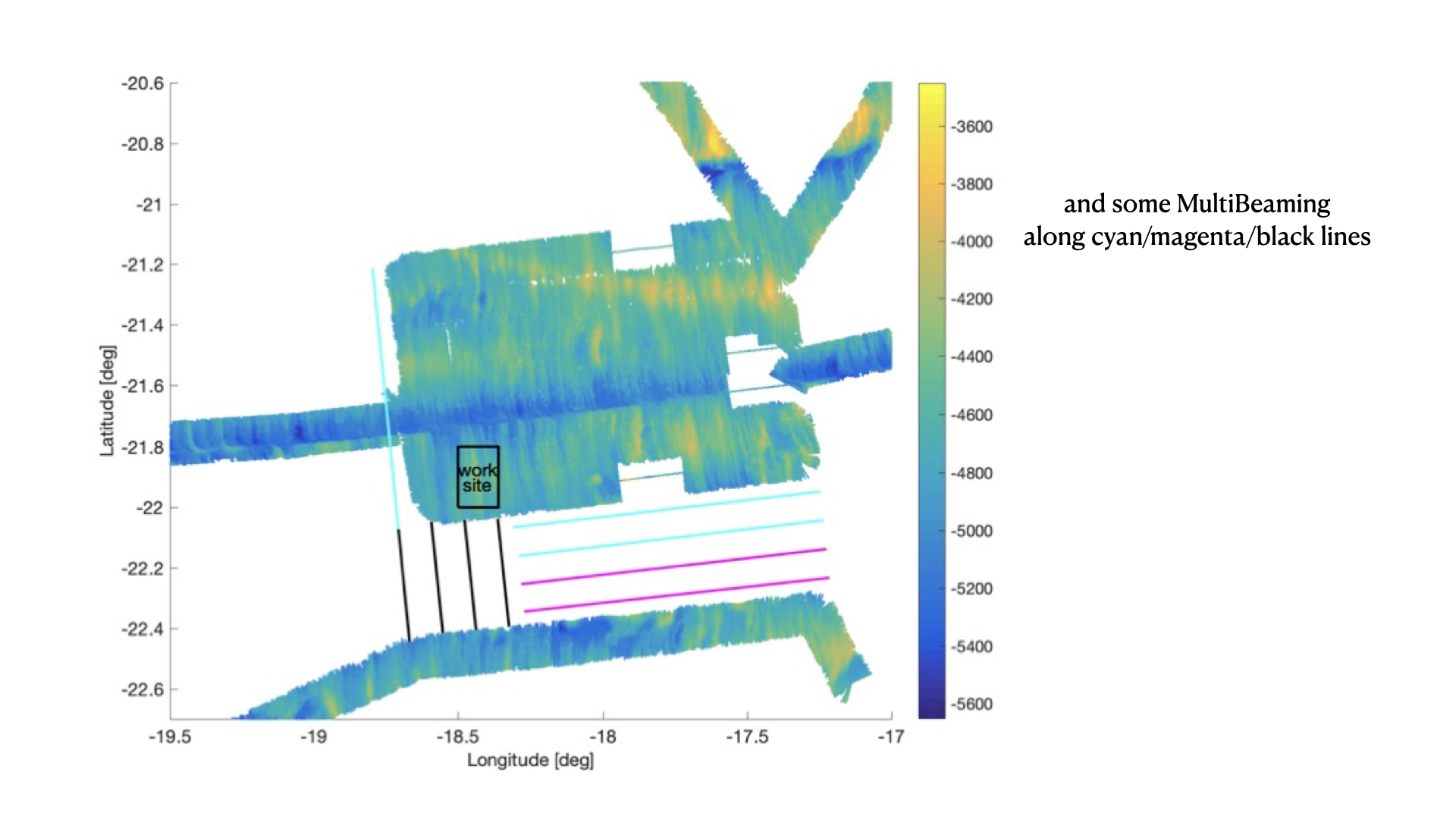
Slide 4: Cyan, magenta and black lines indicate additional multibeam data acquired about the work site in an effort to provide a high resolution map to underpin numerical simulations.