Tracking Zooplankton in Waquoit Bay
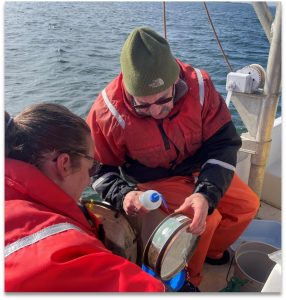 This spring and summer, my lab will be conducting a second season of mesozooplankton sampling within Waquoit Bay National Estuarine Research Reserve (WBNERR). Our goals have been to measure the energetic composition of zooplankton within the bay, and to observe how the amount and composition of zooplankton biomass changes over space and time. We’ve been fortunate in collaborating with the WBNERR staff to sample a set of established stations, where water quality is routinely managed as part of the Bay Watcher’s Program. Last year we found that mesozooplankton abundance was highest in March (our first sampling time) and declined over the summer. Later in the summer, the plankton community was dominated by larger sea jellies and ctenophores.
This March, we resumed sampling and already observed a high abundance of sea jellies…so many jellies that it was hard to sample anything else! Blooms of gelatinous zooplankton can have large impacts on ecosystem structure and function. The jellies are usually carnivorous, preying upon small zooplankton, and potentially competing with fish for food.
The zooplankton composition of Waquoit Bay has not been routinely measured, so it’s hard to know how plankton communities have changed over time. The last published in-depth characterization that I could find is over 20 year old, and focused on copepods (Lawrence et al. 2004). But digging back MUCH farther, I learned that jelly blooms are nothing new in Waquoit Bay. Back in 1898, A.D. Mead wrote (in Science no less): “On April 8th the water at Waquoit was full of Aurelia [a sea jelly], most of the specimens being one to two inches in diameter, though some were much larger…The gelatinous alga [??], so abundant during March and the first half of April, gradually diminished in quantity after the 17th, and on April 25 little or none was found in the nets.” I guess we’ll have to wait and see what we find this April!
References
Lawrence, D., Valiela, I. and Tomasky, G., 2004. Estuarine calanoid copepod abundance in relation to season, salinity, and land-derived nitrogen loading, Waquoit Bay, MA. Estuarine, Coastal and Shelf Science, 61(3), pp.547-557.
Mead, A.D., 1898. The breeding of animals at Woods Holl during the month of April, 1898. Science, 7(177), pp.702-704.
Funding Disclaimer
This research was developed with funding from the Defense Advanced Research Projects Agency (DARPA). The views, opinions and/or findings expressed are those of the author and should not be interpreted as representing the official views or policies of the Department of Defense or the U.S. Government. Distribution Statement “A” (Approved for Public Release, Distribution Unlimited).