Sampling zooplankton with light traps
(This post was written by Sierra Brown)
Hi everyone, I am Sierra, I am a post-baccalaureate researcher at Sea Education Association, and I work in Ann’s lab. I have a bachelor’s degree in biology and have done marine fieldwork on the east and west coasts, Bahamas, and Australia! Since I have been in Ann’s lab I have been sampling and working lots with zooplankton, but for this blog I am going to focus on the weekly sampling I do.
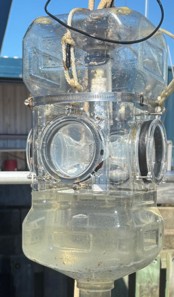
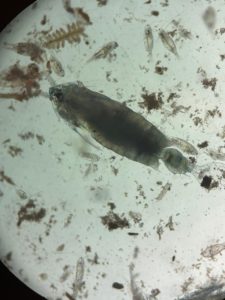
Left: overnight trap draining, with lots of copepods. Right: microscope images of copepods and other zooplankton.
To collect zooplankton, I use light traps which are clear plastic containers with a light in the middle, mesh entrances and a funnel at the bottom into a collection container. Some zooplankton have positive phototaxis which means they move towards the light1,2, these zooplankton are attracted to the lights in our traps which allows us to see their abundance and taxonomic composition throughout the sampling season. I have taken weekly samples since October (about 8 months), with bimonthly samples in January and February because the catch was very small.
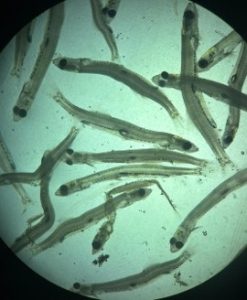
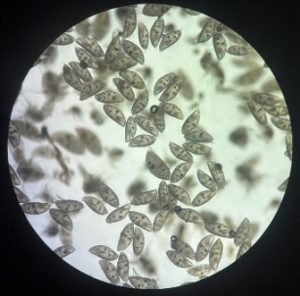
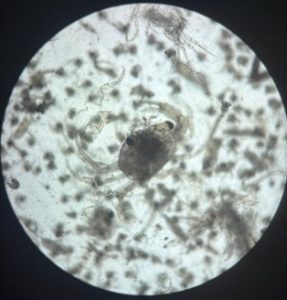
Microscope images of multiple catches. First: sand lance, fish that were present over winter. Second: barnacles, present in early spring with fish. Third: early June catch, contains crustaceans and copepods.
We quantify the catch by taking a wet weight then we identify organisms under a microscope. From October to February, we saw a decline in total catch size, then we started to get lots of larval fish throughout March, April and early May. These fish are likely sand lances and were small enough to fit through our trap openings. During this time, we caught mostly fish and did not see a lot of smaller zooplankton like copepods. Excitingly in the past couple weeks, the end of May and beginning of June, we have been getting lots of copepods and crustacean zooplankton! I will continue sampling weekly through September, and I look forward to seeing how the rest of the season looks.
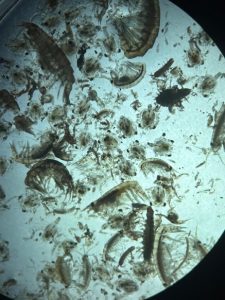
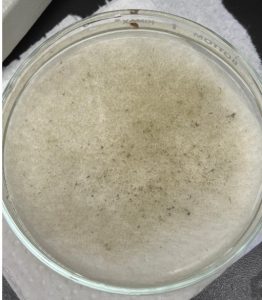
June catches. First: mix of zooplankton under the microscope. Second: lots of copepods.
- Jékely, G., Colombelli, J., Hausen, H., Guy, K., Stelzer, E., Nédélec, F. and Arendt, D., 2008. Mechanism of phototaxis in marine zooplankton. Nature, 456(7220), pp.395-399.
- Hays, G.C., 2003. A review of the adaptive significance and ecosystem consequences of zooplankton diel vertical migrations. Hydrobiologia, 503(1), pp.163-170.
Funding Disclaimer
This research was developed with funding from the Defense Advanced Research Projects Agency (DARPA). The views, opinions and/or findings expressed are those of the author and should not be interpreted as representing the official views or policies of the Department of Defense or the U.S. Government. Distribution Statement “A” (Approved for Public Release, Distribution Unlimited).